Wednesday, February 13, 2013

Learning Morse Code

SO YOU WANT TO LEARN MORSE CODE

Forget Frustration: Gain Valuable Morse Skills
And Increase Your Amateur-Radio Pleasure


By David G. Finley, N1IRZ
Copyright © 1995, 2000. All Rights Reserved*

Note: For complete information on Morse Code training, CW operating, Morse Code history, and more, see the author's book, Morse Code: Breaking the Barrier, published by MFJ Enterprises, Inc..


Amateur license restructuring is here. You no longer need to pass a 13- or 20-word-per-minute (wpm) test to gain full operating privileges. Passing a 5-wpm test gets you everything. However, there are good reasons why you should do more than that. Having a level of Morse proficiency that is of real use on the air, meaning that you can copy at 12-13 wpm or more, will add immeasurably to your enjoyment of Amateur Radio.

Such rewarding HF activities as DXing, contesting and QRP operating still rely heavily on CW. Thousands of hams enjoy CW for its own appeal as a relaxing mode different from most other means of communication. And even on VHF and higher frequencies, you'll find that exciting activities such as Moonbounce and weak-signal work still require Morse skills for full participation.
The pressure to reduce the code-speed requirements came from the widespread perception that getting to 13 or 20 wpm is a nearly imsurmountable barrier. That perception is wrong. For little more investment of time than it takes to pass the 5-wpm test, you can gain real, higher-speed code proficiency that will enhance your enjoyment of the hobby.
Most of what you've been told about learning Morse Code is wrong -- dead wrong. Amateur radio operators traditionally have used the slowest, most frustrating, most painful and least effective techniques possible for gaining code proficiency.
You can gain real code proficiency. You can do it in a reasonable amount of time and with a minimum of frustration and pain. In order to do so, you must approach code training from a different perspective and use different techniques from those common among amateurs for the past half century.
It will require work (just as it does to get to 5 wpm). You will have to commit yourself to at least one 15-30 minute training session every day until you reach your goal. You may succeed in a month or in several months; individuals differ greatly. Without this committment, however, you may as well not bother.
So what's new here? By using a code training method devised by the German psychologist Ludwig Koch some 60 years ago, you will progress as quickly as you possibly can, with ample reinforcement and little frustration. By understanding this method and how it builds your code proficiency, you will know why you have to spend time practicing and you'll be able to make a reasonable prediction of how long the total effort will require.
We're going to start on your road to success by throwing some time-honored ham-radio traditions onto the trash heap where they belong. These are:

  • Slow (5 wpm) code -- It ought to be illegal to teach anyone code at 5 wpm. Every minute spent toying with 5 wpm code is irrevocably wasted. In addition, as we'll see later, starting with slow code is a virtually-guaranteed path to frustration and quitting. Morse at 5 wpm and Morse at 15 or 20 wpm are completely different critters, and you don't want to waste time on the wrong one.

  • Charts, mnemonics, musical cues and other "memory aids" -- These things make you think about what you're doing while trying to copy code. That is deadly to proficient copying.

  • Code tapes -- In very short order, and unconsciously, you'll memorize the tape. This will lull you into false confidence in your ability. That false confidence will be quickly shattered when you hear transmitted text that you haven't memorized.

  • Copying QSOs off the air -- You don't know the speed of code you find on the bands, and much code on the air is pretty badly sent. All this makes it useless for training purposes. Formal code-practice sessions, such as those on W1AW, are OK, however.
Now that you know what you're not going to do, let's start examining just how you can best gain code proficiency.

The Mechanics: Just what is code training, anyhow?

Go to the shack of a veteran CW operator, or visit the CW station at a club Field Day operation. Watch people copy and send code at 30 to 35 wpm. You'll notice they're pretty relaxed about it; they're not sweating each character as it comes out of the speaker and they're not racking their brains to "figure out" what's being sent. Code has become second nature to them.
That's the key to code proficiency. Copying code must be a thought-free process. When you hear a character, you should know, without thinking, what it is. It should be a reflex. In fact, copying above about 10 wpm can only be done by reflex. Above that speed, thought processes are too slow to succeed.
That's why slow code is a deadly trap, and why traditional amateur methods of code training are so painful and frustrating. Most hams are told to memorize all the characters, then start building their speed. When you do it this way, you build a "lookup table" in your brain, comparing each character you hear with those in the lookup table until you find a match. This process shuts down from overload at about 10 wpm. That's why people experience a "plateau" at 10 wpm, and don't see any progress for weeks or months.
Those who finally get over that "hump" and progress beyond 10 wpm do so because, through constant practice, they have begun to copy code by reflex instead of by thought. They are the lucky ones; this 10 wpm barrier is where many folks give up out of frustration.
Code training, then, should completely bypass the lookup-table phase and begin by building copying proficiency as a reflex. This was recognized in the 1930s by the German psychologist Ludwig Koch, who devised the most efficient method known for Morse training. It's his method, and how you can use it, that we're going to examine in detail.

Morse Training by the Koch Method

Koch's method is a simple, direct way of building reflexes. However, it requires either a computer and Morse software or a personal trainer. That's why it was overlooked for so many years. Now that computers are commonplace, it should become the standard Morse training method. Here's how it works:
You start out by setting up your computer (or a microprocessor-based code tutor machine) to send you Morse characters at 20 wpm and at an overall sending speed of at least 15 wpm. You then get out your paper and pencil and have the machine start sending -- but only two characters. That's right, for your first sessions, you'll only have two choices. Copy on paper for five minutes, then stop the machine and compare what you copied with what the machine sent. Count characters and calculate your percentage of correct copy.
If your score is 90 percent or better -- congratulations! You just learned your first two characters, and, importantly, you learned them at full speed. You'll never have to learn them over again. If you didn't make 90 percent, practice some more. As soon as you can copy the first two characters with 90 percent accuracy, add a third character to your practice. Your accuracy will drop as you work on assimilating the new character, but it will rise again to 90 percent or better. Then you add the fourth character, and so on.
This method does not allow you to build that lookup table in your brain. To copy at full speed, you must build the reflexes in order to achieve 90 percent accuracy. And that's what you're spending your time doing -- building reflexes. Think of it as a parallel to perfecting a tennis swing or mastering a gymnastic routine; you're practicing until you get it right. The Koch method of building code proficiency character-by-character is similar to standard methods of teaching touch typing, another skill that must be reflexive.
This is a very individual method of training -- you progress at your own best speed, and spend only the time required to gain each new character. This means that you will waste no time in reaching your goal.
How much time is required? That will depend on the individual. Koch himself, with hand-picked students, got a group to master 12 wpm code in a mere 13.5 hours. You probably won't match that, but that's much faster than any other method in the psychological literature. You can get an idea of how long it's going to take after you've mastered a few characters. Keep track of your training sessions (some software will do this for you) and calculate your hours-per-character rate (or characters-per-hour if you're really fast!). That, multiplied by the 43 characters in the amateur Morse test, will give a rough idea of how long it's going to take.
While the Koch method is the fastest method of Morse training, speed alone is not its principal advantage. Its principal advantage, and a major difference from other methods, is that it provides you with constant positive reinforcement. This begins with your realization, after mastering the first two characters, that you can copy code at 15 or 20 wpm, because you just did it. After that, each new character mastered is further proof of your progress. Contrast that to slowly trying to build speed up from 4 or 5 wpm, then hitting the plateau at 10 wpm and seeing no progress for a long time. With the Koch method, frustration is at a minimum.
Constant testing is necessary to ensure that you maximize the effectiveness of the Koch method. You must copy on paper, so you can grade yourself. Remember, if you score 90 percent accuracy or better, add another character. If you score any less than that, try again. By constantly testing yourself on continuous copying of at least five minutes, you know exactly how you're doing and exactly when you should add another character. This results in the fastest progress possible.
Naturally, with the Koch method, you'll be copying random groups of characters, rather than words, until you've mastered the entire character set. If your software allows, make these groups of random length, rather than a constant stream of five-character groups. This will ease the transition from random groups to actual words. Yes, there is a difference in the rhythm and "feel" of words and random groups. Once you've become accustomed to copying words, you should start copying sample QSOs, which are the format of the amateur tests. Pay special attention to callsigns, locations, and numerals; these are the types of things that can form questions on the test.
As you proceed toward your goal, remember that some days are just going to be better than others and some characters will take longer to assimilate than others. You know, however, that you can reach your goal because you've already mastered some characters and proven that copying at full speed is something you can do. Keep in mind that what you're doing is building reflexes, and that takes time. The amount of time you require has nothing to do with your intellegence; it's just how long it takes for characters to "sink in" and become part of your reflexes.
So there it is -- your path to real, useful Morse Code proficiency. After you've used this method, and start enjoying the wonderful world of HF radio, try a few CW QSOs. With Morse code developed as a reflex, you may just find that you really enjoy using it on the air. After all, you've gained proficiency without the frustrating ordeal that most hams have endured for decades. See you on the HF bands!
Questions? They're probably answered in Morse Code: Breaking the Barrier, the author's complete book on code training and CW operating, published by MFJ Enterprises, Inc. It's available now for $19.95 plus shipping. Call (800) 647-1800 and ask for stock number MFJ-3400.

Bibliography
Finley, D.G., "Reducing the Barrier: Effective Morse code training," Radio Fun, May 1995, pp. 14-15.
Finley, D.G., "Effective Training for High-Speed Morse: An Auditory-Learning Based Model," Morsels, Volume 2, Number 2, Fall/Winter 1996/1997, p. 3.
O'Keeffee, V., "Learning Morse," QST, August 1972, pp. 58-62.
Peak, H., "Koch's Method of Learning Code Reception," Psychololgical Bulletin, XXXIX (1942), p. 495.
Taylor, D.W., "Learning Telegraphic Code," Psychological Bulletin, XL (1943), pp. 461-487.
Taylor, D.W., "The Learning of Radiotelegraphic Code," American Journal of Psychology, LVI (1943), pp. 319-353.

A Personal Note

These ideas may sound very bold and unconventional, but I know they work, because they worked for me.
I fell in love with radio in grade school, but was kept off the air for 30 years because I found traditional code training just too frustrating. During those decades, I tried several times to learn Morse, but every time gave up in frustration and disgust -- my progress was just too slow.
In 1991, I became one of the first 500 people to enter ham radio by way of the no-code Technician license. After becoming bored with repeaters and HTs, I decided to make one last attempt to master the code. Fortunately, I stumbled on information about Koch's method, and found that it was the only thing that would work for me. In 1993, after diligent work at my computer, I took my first code test and passed the 20 wpm exam on the first try.
I became very curious about why Koch's method had worked for me when all else had failed. That sent me to libraries to read the now-aging psychological literature about Morse training. I soon realized that the Koch method achieves its speed through directness; if you want to copy reflexively at 15 or 20 wpm, then just start building those reflexes from the start. I also realized that it provides much more positive feedback than any other method, so you can keep your motivation and a "can-do" attitude throughout your training.
This was knowledge I wanted to share with others, so I began giving lectures to amateur groups on the topic. I quickly found that, after my lectures, "old-timers" would come up and tell me that my ideas on the need for reflexes were absolutely right. Many said that the Koch method sounded similar to the intense code training they had received in military schools.
Probably the only reason Koch's method didn't become standard back in 1936 when he first published it was that the average individual had no way of implementing it. The personal computer has changed that, and the time has come for the Koch method to replace all others. I hope that the speed and positive-reinforcement aspects of the Koch method can cut down the code barrier to a much less formidable size.
Prior to the FCC's restructuring of amateur licensing, the percentage of U.S. hams who had passed at least a 13-wpm code test had long since become a minority and was dropping steadily. This "code barrier" was causing an unhealthy stagnation in the amateur ranks. Many readers of Morse Code: Breaking the Barrier wrote to tell me how the Koch Method had helped them overcome many years of frustration and upgrade their licenses. It was gratifying to hear of these success stories. Now, people can use the Koch Method, not because they have to pass a test, but because they want to increase their amateur-radio pleasure.
I cannot overemphasize my dislike -- even hatred -- for 5 wpm code. As I've outlined above, it is highly counterproductive to gaining proficiency at higher speeds. In order to go from 5 to 13 wpm, you have to start over again, even though you may not realize that while you're doing it. The worst aspect is that many people pass a 5-wpm test, then never go beyond that. Why waste your time learning a skill (slow code) that has no relevance to real (13+ wpm) code proficiency and is of almost no use on the air?
Finally, as I was using the Koch method and building my code skills, I intended to forget the code as soon as I passed the test. My 30 years of frustration had built up a bitterness about CW. However, about two weeks after getting my first HF rig on the air, I looked at my straight key and decided to try a CW QSO "just so I can say I did it." Guess what? I enjoyed it. My second CW QSO was with a DX station, and I was hooked. With the encouragement of a CW Elmer, I continued to enjoy the bottom parts of the bands, and now my microphone isn't even plugged into the rig!
If the Koch method could overcome three decades of bitterness and turn me into an enthusiastic CW operator, I think it's certainly worth a try on your part. Have a go at it. Maybe I'll find you on the CW bands and we can have a ragchew.
Best of luck, and 73.
Dave Finley, N1IRZ

* This article is copyrighted by the author. Permission is hereby granted to transmit and distribute it by electronic means and to store it on electronic bulletin board systems, and for individuals to download and print copies for noncommercial, personal use, provided that the article is transmitted, stored and printed unaltered and in whole, including this notice. For any other use, written permission from the author must be obtained.

Tuesday, February 12, 2013

Ride the Wave


On the Air: Ride the Wave in the 2013 ARRL International DX CW Contest

Eric Hall, K9GY, of Lansing, Illinois, headed down to Nicaragua for the 2008 running of the ARRL International DX CW Contest. [Photo courtesy of Eric Hall, K9GY]

CW DXing and contesting take center stage the weekend of February 16-17, as the 2013 ARRL International DX CW Contest takes to the airwaves. If you've never operated the CW contest, now is the time to start. "You can work a lot of DX with 100 W and a simple dipole or vertical antenna," explained ARRL Contest Branch Manager Sean Kutzko, KX9X. "Some stations -- with some perseverance -- have worked more than 100 DXCC entities during the contest period. And who knows? You just might achieve DXCC during the contest." Read more here.

Sunday, February 10, 2013

The Case for CW: By James Wades, WA8SIW

The Case for CW

For nearly two decades now, a vocal group of radio amateurs have pushed for the elimination of telegraphy
exams as a prerequisite to Amateur Radio Licensing. Many of these individuals have formed opinions about
radiotelegraphy based on little or no knowledge of its history or applications.

With the elimination of the FCC Element One telegraphy exam for all classes of Amateur Radio License, it is
hoped that individuals will now take a more dispassionate, logical look at radiotelegraphy, without concerns
regarding possible hidden agendas or other politics related to the regulatory process.

It is the purpose of this article to provide an opportunity for new radio amateurs, and others, to gain some insight into the advantages of radiotelegraphy. Ideally, the reader will walk away with a few myths dispelled and perhaps some valuable insights into the motivations of those individuals who continue to strongly support and promote radiotelegraphy despite the development of many new automated digital techniques. Most importantly, it is hoped this article will encourage new radio amateurs to learn and use “CW.”

The beginning…Morse Telegraphy

The fountainhead of all modern communications is the electromagnetic telegraph. The telegraph was a true
revolution in telecommunications. It standardized time, made safe rail transportation possible, and revolutionized industry, war, and commerce. It transformed local stock and commodities exchanges into worldwide engines of capitalism and economic progress. The telegraph supported the development of other modern infrastructure, from pipeline storage and distribution systems to modern urban fire departments.

In comparison to the telegraph, its modern successor, the Internet, is simply a refinement. It accomplishes the
same tasks more efficiently, but fundamentally, it still performs the same tasks as the telegraph. The real revolution occurred nearly 150 years earlier.

It is interesting to note that the electromagnetic telegraph saw commercial use well into the mid 1980s, at which time it remained in use in railroad, brokerage, and similar business applications. Sadly, modern historians tend to overlook the history of the telegraph, resulting in the general perception that it disappeared with the development of the telephone. Ironically, even the Bell System utilized telegraphy to coordinate the repair and maintenance of long-distance telephone tool circuits, radio and television programming distribution networks, and the like. Telegraph systems were typically less expensive to utilize, easier to maintain, and telegraph carriers could be composited to operate simultaneously on voice circuits.

There must be a reason this very basic technology survived well into the late 20th Century, and it had everything to do with efficiency!

Radiotelegraphy:

The development of wireless communications in the late 19th and early 20th century brought the application of telegraphy to radio communications. For the first two decades of the 20th Century, voice communications was difficult to accomplish. The reasons for this are somewhat technical, however, a brief explanation is in order.

Early radio transmitters produced a damped oscillation caused by discharging a high voltage spark across a
parallel resonant circuit, which was then coupled to an antenna system. The process was somewhat like ringing a bell. Each high voltage discharge across the gap would excite the L-C circuit, which would then “ring” at its resonant frequency with a decreasing amplitude (decrement) over time until again excited by the succeeding high voltage spark discharge. The “damping” effect associated with early spark transmitters made it impractical to modulate these early RF carriers.

In an attempt to overcome the deficiencies of early spark technology, continuous wave transmitters were
developed, which produced undamped oscillations. The earliest versions produced high-power, long wave signals utilizing alternator and arc technology. While this improved efficiency through better energy transfer and narrower bandwidth, such systems were also difficult to modulate due to the high power levels employed.

Only with the development of reliable, stable vacuum tube transmitters in the late ‘teens and early twenties did it become possible to efficiently transmit voice communications. Low-level circuits could be modulated at manageable levels, and the modulated signal could then be amplified to achieve the needed power output and coverage area required of the radio transmitter. This gave birth to a wide range of technological applications such as commercial radio broadcasting, police radio dispatching, long-distance radiotelephony, and so forth.

It is interesting to note that utilizing “CW” as a description for radiotelegraphy is somewhat of a misnomer dating from this early period. The term actually arose to differentiate a continuous wave radiotelegraph transmitter from its predecessor spark technology. In a sense, all modern radio and wireless devices utilize continuous wave, from 1920s radio transmitter to the latest cellular telephone or Wireless Internet device!
Why CW?

So why did radiotelegraphy, or “CW” remain in widespread use for so many years after the development of voice communications? Why is it still utilized today for some applications? Why do so many radio amateurs place so much emphasis on what often seems to the uninitiated “just another mode of communications.” The answers are many!

Efficiency:

A competent radiotelegraph operator can transfer information at a speed of perhaps 40 to 60 words per minute. The average person on the street talks at speeds ranging from 200 to 300 words minute. Yet, the radiotelegraph operator will often clear message traffic at speeds ranging from two to four times faster than a voice operator handling identical traffic. It seems paradoxical doesn’t it? The reasons for this are surprisingly straightforward.

First, voice methods encourage unnecessary language. The convenience of voice methods, and their similarity to daily, casual discussion, guarantees that a radio operator will trend toward adding unnecessary phrases, comments, and clarifications. The perception that plenty of time is available on the radio circuit due to the immediacy and convenience of voice communications encourages operators to “think aloud,” and engage in spontaneous, informal communications and problem solving.

Second, even when voice methods are managed through strict discipline and training, such as on military radio circuits, problems arise. The letter “B” sounds like “D,” which in turn sounds like “E,” and “C” and so on. Therefore, it becomes necessary to institute phonetic alphabets and similar procedural phrases to maintain accuracy. When such practices are bypassed in favor of speed, receiving operators tend to make assumptions about the meaning and nature of words, which may only have been partially perceived. For example, a public health message in reference to “pneumonic plague” is transcribed as “bubonic plague.” “Ethyl” becomes “Methyl” within a complex chemical name, and so on.

Radiotelegraph operators, on the other hand, trend toward eliminating unnecessary language. The fact that the individual operator naturally “thinks” faster than he/she can send constantly encourages the elimination of any unnecessary word, phrase of procedure. Furthermore, phonetic alphabets are unnecessary due to the fact that every sound pattern for the various Morse characters is absolutely unique. For example, complex chemical name containing “Methyl” or “Ethyl” are more likely to be transcribed accurately.

It is not uncommon to hear one operator transmitting a quantity of messages to a receiving station, only to hear a single “dit” as acknowledgement of receipt between the messages. This is an example of the trend toward limited language inherent in CW methods. In this example, both operators intuitively understand that the “dit” indicates acknowledgement.

Both a language and a system:

Radiotelegraphy is unique in the world of radio communications because, in the hands of an experienced
operator, it becomes a hybrid between a communications method and a natural language. As such, it combines the best benefits of a digital radio system with the intuitive nature of language. The skilled operator thinks in Morse, he processes the language of Morse “in his mind” in the same way he responds to voice communications, yet, when it comes time to transcribe information, he can do so with greater accuracy due to the “digital” nature of the mode. The operator can seamlessly move from a basic discussion or tactical problem solving mode to a record message traffic exchange with ease.

This is a difficult concept for the beginning radio operator or the uninitiated to understand, particularly when his experience with Morse is limited to 5 or 10 words per minute and before he has successfully made the transition to the point where he can process Morse in the same manner he does the spoken word. As in the case of learning a foreign language, it takes time and effort to develop the skills necessary to utilize Morse as a language. However, once one does, an entire new world of communications efficiency opens to him.
Technical benefits:

We have all heard the tired old explanation that a simple CW transmitter can be easily constructed from just a few parts. This is true, but few today are willing or qualified to do so. However, CW offers a variety of benefits, which make it ideal for basic emergency communications.

First, a 10 to 20 watt CW transceiver offers the same level of efficiency as a 50 to 100 watt voice (SSB) transmitter
. This has everything to do with bandwidth. Whereas a CW signal occupies perhaps 200 Hertz of spectrum, voice and some data transmissions occupy up to 4000 Hertz of spectrum. So why is this important?

In a disaster situation, one can operate a CW transmitter and communicate reliably in an net situation for days utilizing little more than a couple of lantern batteries or gel cells as a source of primary power due to the low RF power output required for reliable communications. In order to accomplish the same level of reliability, a voice transmitter requires a generator and fuel for extended operation. Those that suggest this is a minimal obstacle have never tried to locate fuel in a disaster area, nor have they tried to compete with police departments, fire departments, state and federal agencies, hospitals, and other critical services for any fuel that remains available.

Drop a CW operator into a disaster area with a simple man-pack radio, a couple hunks of wire, a solar panel and a few gel-cells, and one has a reliable communications system, which can operate indefinitely. Unlike those operators employing digital modes, he will not need to worry about powering a laptop computer, PDA, and similar peripheral devices, all of which consume additional power. Furthermore, many computers and electronic devices are easily damaged by environmental factors, such as rain, vibration, and so forth. A simple CW unit can be kept nice and dry, with only a simple key exposed to the elements.
Multiplexing:

Set up a radio network with multiple stations, and one quickly discovers that occupied bandwidth is an issue for other reasons. A CW net can efficiently dispatch multiple stations off-frequency to simultaneously exchange message traffic with minimal impact on overall spectrum use. Unfortunately, voice nets find that the same technique creates real problems. Send two voice operators to simultaneously exchange messages on adjacent frequencies, and one quickly discovers that a single net operation is now consuming a minimum 10.5 KHz! Toss in a couple speech processors or inappropriately adjusted transceivers, and that figure expands yet further.

The fact is, a single CW net can send several traffic exchanges off the main net frequency and still have less
impact on adjacent users than a single voice net. 

Q-Signals

Q-Signals, procedural signs (prosigns), and the like offer little advantage on voice, yet they do wonders on CW. A net control operator may say WB8SIW QNY K8SIW d 3 SEOC. Both stations respond with a simple “dit” and they are now 3 KHz lower exchanging a message for the State Emergency Operations Center.

Q-signals, Z-signals, and similar abbreviations and prosigns convey tremendous amounts of information with
minimal time and effort. Unfortunately, they do not translate well to voice operation for the reasons mentioned above.

Language barriers:

Not only do Q-signals and prosigns translate universally via CW, a qualified CW operator can transmit and
receive messages written in many foreign languages without knowledge of the language itself. The International Morse Code is quite universal and facilitates message exchange despite barriers that would be insurmountable using voice methods.
Basic level of security.

While it is true that some computer programs can detect and decode CW, they often respond poorly to hand-keyed Morse. Additionally, Morse nets are difficult to locate unless one has some prior understanding of net times, frequencies, and procedures. A typical media outlet is not likely to comprehend “QNY D 3” or QMN QNA SEOC.” Rather, they will seek out the voice nets, which are easily understood and followed with a minimum of effort. For situations in which a degree of confidentiality is required, CW is an excellent choice.

CW offers an additional advantage. Whereas voice nets are often inundated with spontaneous, untrained
volunteers in time of emergency, CW nets often continue to operate unaffected. While the unfortunate voice
operators are contending with inexperienced individuals, poor procedures, and unnecessary language, the CW net keeps right on moving traffic, often at peak efficiency.

Analogs:

Many anti-CW operators point to the fact that the Department of Defense and maritime services no longer utilize CW. This is not entirely true. US Army Special Forces personnel are still trained in Morse, and many of the world’s militaries still utilize it, albeit to a lesser extent than in years past. In fact, the military and maritime services have not so much abandoned CW as they have abandoned the High Frequency infrastructure, which once required its use. Global satellite platforms now support much of our military and maritime communications. As such systems are immune to selective fading, geomagnetic storms, and similar propagation anomalies, there is little need for CW.

Unfortunately, Amateur Radio does not have access to a stable, geosynchronous satellite system. Instead,
Amateur Radio continues to rely on High Frequency spectrum for a much of its statewide, regional, and
international communications. Such spectrum continues to prove problematic for high-speed digital modes and voice communications due to occasional solar flares and the like.

CW does offer tremendous advantages under poor propagation conditions. This fact, combined with the
advantages noted above continues to render CW of value for both routine and emergency communications functions via Amateur Radio.
Digital Modes:

Today, radio amateurs have access to numerous digital modes, some of which occupy limited bandwidth and
offer surprising reliability. However, problems arise here as well. Whereas SSB and CW are common denominators, readily available on nearly all High Frequency transceivers, digital modes are not. Visit a random sample of 100 digital equipped operators, and one quickly discovers that no common system is universally available. Unlike an army signal battalion, which has universal standards enforced to insure interoperability and uniformity, no such standards exist within Amateur Radio. One will encounter different terminal software, different TNC command structures, and a variety of different digital capabilities.

In reality, voice and CW are the only universally available common denominators within Amateur Radio. A
qualified operator can walk up to any HF transceiver, plug in a microphone or key, and communicate instantly on a radio circuit, regardless of the age or type of HF radio transceiver.

It is interesting to note that many digital modes are also cumbersome in a net configuration. Whereas break-in CW offers instant access to a radio net for high-priority traffic, this feature is difficult to implement on a digital radio net. As stated earlier, the fact that CW combines both language skills and many features of digital communications allows a single net control station to quickly check individuals in and out of nets, provide rapid instructions, and yet clear traffic accurately. This is one reason why many emergency drills have revealed that CW nets are consistently more efficient than PSK-31, MFSK-63, and similar modes.
Is Amateur Radio needed?

Some will argue that modern cellular telephone, Internet, and satellite infrastructures are sufficiently developed to the point where High Frequency communications is no longer needed. The argument is somewhat inferential; if Amateur Radio HF resources aren’t needed, then by extension CW is not needed. As such, any imperative to learn or develop CW proficiency is moot.

The devastation of Hurricane Katrina revealed the fragility of our nation’s common carrier infrastructure.
Ultimately, satellite telephones provided significant service for many government agencies. However, satellite
telephones have some significant disadvantages, not the least of which is cost. The average call via satellite
telephone can range from 1 to 3 dollars per minute, a steep price for many non-profit relief organizations. Satellite telephones are also problematic when utilized inside buildings.

Most modern telecommunications networks are extremely reliant on the electrical power grid. The distributed nature of networks means many nodes, control points, and RF access points are backed-up only by battery power. This is sufficient for 99 percent of power outages, which may last only hours or days. However, it is extremely insufficient for long-term outages. The fact is, any major disruption to the US electrical power grid due to natural disaster, technological disaster, or coordinated terrorist attack is likely to disrupt extensive segments of most modern networks. Yet, a HF equipped CW operator will be able to efficiently transfer basic text information indefinitely through the use of renewable energy and similar techniques.

Sadly, both the general public and the US government have been lulled into a level of complacency. Our
infrastructure is the best in the world and it is so ubiquitous and reliable, most individuals are incapable of imagining a situation, which may render large portions of it inoperative. Yet, such hazards do exist and do occur from time-to time. Non-profit and decentralized:

There remains a place in society for a non-profit, decentralized radio service that is neither dependent on
extensive infrastructure nor controlled by any particular government or business organization. Amateur Radio offers independence, survivability, and remains an unprecedented disaster communications resource.

CW in general, and CW nets in particular offer great reliability and tremendous efficiency for both casual use and emergency communications. The wise radio amateur will want to invest the time and effort necessary to become fluent in the language of radiotelegraphy. It is not only fun, but incredibly useful as well.

Author: James Wades
-30

COPYRIGHT 2006: James Wades, WA8SIW, for the Michigan Net, QMN and National Radio Emergency Net. This article may be reproduced and distributed provided credit is given to the author and the Michigan Net, QMN and National Radio Emergency Net.

Thursday, February 7, 2013

Tiny Japanese satellite beams Morse code from space


An ultra-small Japanese satellite is being spotted from the ground, thanks to a set of lights that flash brightly in Morse code.
The novel cubesat, known as FITSAT-1, has been orbiting Earth since early October of last year. Though it tips the scales at less than 3 pounds, FITSAT-1's powerful light-emitting diodes (LEDs) make it a compelling target for skywatchers.

"As long as the LEDs are active, then you will be able to see it using binoculars," veteran Canadian satellite watcher Kevin Fetter told SPACE.com

An artificial star

FITSAT-1 was built at Japan’s Fukuoka Institute of Technology. The tiny spacecraft is also called Niwaka, after "Hakata Niwaka," an improvised performance of traditional Japanese comedies with masks.

The spacecraft was carried up to the International Space Station on Japan's unmanned H-2 Transfer Vehicle-3 in July 2012, then deployed from the orbiting lab in October by Japanese astronaut Aki Hoshide. [Photos: Tiny Satellites Launch from Space Station]

To cast FITSAT-1 and two other cubesats off into space, Hoshide used the Small Satellite Orbital Deployer that was attached to the Japanese Kibo module’s robotic arm.

FITSAT-1’s orbit is taking it between 51.6 degrees south latitude and 51.6 degrees north latitude. The cubesat contains a neodymium magnet that forces it to point always to magnetic north, like a compass.

Working well

A successful test of FITSAT-1's LED optical beacon took place over Japan on December 11.

"All functions of FITSAT-1 are sound and work very well," said Takushi Tanaka, leader of the project at the Fukuoka Institute of Technology.

Images of the blinking FITSAT-1 have been taken in Japan, Germany and the United States, Tanaka told SPACE.com. The tiny spacecraft has succeeded in its primary goal of investigating optical communication techniques for satellites, he said.

For Niwaka to be visible, the night sky must be dark enough that a ground observer can see the Milky Way, Tanaka has said. Also, many people are unaware that they have succeeded in photographing the fleeting, flashing light until they've magnified and closely inspected their images.

The FITSAT-1 team attempts to accommodate skywatchers who want to catch a glimpse of the little satellite.

"As observing the light is not so easy, we will flash the light on requests. If you have a plan for observing the light, please advise me [of] the time and date with your latitude and longitude," Tanaka wrote on the FITSAT-1 website. "Now we have a plan for flashing at 09:25:00 on 9th Feb. for the west coast of USA."

Amateurs of space

Tanaka is no aerospace specialist. He's a professor of computer science and engineering, with research interests that specialize in artificial intelligence, language processing, logic programming and robot soccer, in addition to cubesats.

The backgrounds of Tanaka and his team make Niwaka pretty special, the researcher said

"Most cubesats are developed by some kind of space department of a university, while FITSAT-1 is developed by amateurs of space." Tanaka said.

"Though I do not have much knowledge about space," he added, "I am a ham radio [devotee] since the age of the vacuum tube."

Tuesday, February 5, 2013

New HAM's

As most know, we held testing at the picnic and had 3 folks become new Tech's. This past Saturday, the 2nd of Febuary we also had a session. That gave us 3 new Techs as well.

All are listed below.

KK4OFX Rubin Sepulueda
KK4OFY Phillip Maffett
KK4OFZ Neftali Marrero
KK4OAM Bill Carson
KK4OAN Thomas Morrison
KK4OAO Bill Johnson

Make sure to say hello if you hear them.

Thursday, January 31, 2013

ARRL Upcoming Radiosport Events

This Week in Radiosport
 
This week:
  • February 1 -- NCCC Sprint Ladder
  • February 2 -- Minnesota QSO Party; AGCW Straight Key Party
  • February 2-3 -- Vermont QSO Party; Mexico RTTY International Contest; 10-10 International Winter Contest (SSB); Black Sea Cup International; EPC WW DX Contest
  • February 2-4 -- Delaware QSO Party
  • February 3 -- North American Sprint (CW)
Next week:
  • February 8 -- NCCC Sprint Ladder
  • February 8-10 -- YLRL YL-OM Contest
  • February 9 -- Asia-Pacific Spring Sprint (CW); FISTS Winter Sprint
  • February 9-10 -- New Hampshire QSO Party; Louisiana QSO Party; CQ WW RTTY WPX Contest; YL-ISSB QSO Party (CW); KCJ Topband Contest; Dutch PACC Contest; OMISS QSO Party; RSGB First 1.8 MHz Contest; AWA Amplitude Modulation QSO Party
  • February 10-11 -- Classic Exchange (Phone)
  • February 11-15 -- ARRL School Club Roundup
  • February 13 -- NAQCC Straight Key/Bug Sprint
  • February 13-14 - CWops Mini-CWT Test

From The ARRL Letter for January 31, 2013

Monday, January 28, 2013

Picking a Band


160 and 80 Meters
Eighty meters, and its phone neighbor, 75 meters, are favorites for ragchewing. I frequently check out the upper frequencies of the CW subband. There I find both newcomers as well as old-timers trying to work the rust out of their fists. Around 3570 kHz you'll find the digital modes, including RTTY, PSK31 and packet. The QRP frequency is 3560 kHz. If you hear a weak signal calling CQ near 3560, crank down your power and give a call. Another favorite frequency is 3579.5 kHz. If you live in the eastern half of North America, listen for W1AW on 3581.5 (CW), 3597.5 (digital) or 3990 kHz (SSB). W1AW runs 1000 W to a modest antenna — an inverted V at 60 feet. If you can copy W1AW, you can probably work the East Coast, even with low power. AM operation is generally found between 3870 and 3890 kHz.
 
Even if you can't chase DX, you will find plenty to do on either band. Ionospheric absorption is greatest during the day, thus local contacts are common. At night, contacts over 200 miles away are more frequent, even with a poor antenna. Summer lightning storms make for noisy conditions in the summer, while winter is much quieter. You may also be troubled by electrical noise here. A horizontally polarized antenna, especially one as far from buildings as possible, will pick up less electrical noise.
 
Topband, as 160 meters is often called, is similar to 80 meters. QS0s here tend to be a bit more relaxed with less QRM. DX is frequent at the bottom of the band. Don't let the length of a half-wave dipole for 160 keep you off the band; a 25- or 50-foot "long wire" can give you surprisingly good results if a good ground system is available. One favorite trick is to connect together the center conductor and shield of the coax feed line of a 40- or 80-meter dipole and load the resulting antenna as a "T," working it against the station ground.

60 Meters
Unlike other HF amateur bands, 60 meters is channelized. This means that you have to operate on specific frequencies. Amateurs have secondary access to this band. They cannot cause interference to and must ac cept interference from the Primary Government users. Amateurs can transmit CW and PSK31 on the following channel-center frequencies: 5332.0, 5348.0, 5358.5, 5373.0 and 5405.0 kHz. Amateurs can also transmit upper sideband (USB) voice and PACTOR III on the following suppressed carrier frequencies (the frequencies typically shown on transceiver displays): 5330.5, 5346.5, 5357.0, 5371.5 and 5403.5 kHz.
 
Amateurs may transmit with an effective radiated power (ERP) of 100 W or less, relative to a half-wave dipole. If you're using a commercial directional antenna, FCC Rules require you to keep a copy of the manufacturer's gain specifications in your station records. If you built the directional antenna yourself, you must calculate the gain and keep the results in your station records.
 
When using a directional antenna, you must take your antenna gain into account when setting your RF output power. For example, if your antenna offers 3 dB gain, your maximum legal output power on 60 meters should be no more than 50 W (50 W plus 3 dB gain equals 100 W ERP). Despite the limitations, it has intriguing potential. The propagation on 60 meters combines the best of 80 and 40 meters.

40 and 30 Meters
I must confess to being biased in favor of these bands, especially 40 meters. If I could have a receiver that covered only one band, it would be 40. Running 10 W from my East Coast apartment (indoor antenna) I can work European hams, ragchew up and down the coast, check into Saturday morning QRP nets, and listen to foreign broadcast stations besides. Yes, 40 is a little crowded. Look at the bright side: You won't be lonely. I think it's possible to work someone on 40 any time of the day or night.
 
In the US, Advanced and Extra licensees have voice privileges starting at 7125 kHz and the General band starts at 7175 kHz. Most other countries have SSB privileges down to 7050 kHz so don't be surprised if you hear voice stations below the US phone band. At night you may hear foreign broadcast stations above 7200 kHz. During the day, they won't bother you much. Forty is a good band for day time mobile SSB operation, too. You'll find plenty of activity, and propagation conditions tend to be stable enough to allow you to ragchew as you roll along.
CW QRPers hang around and above 7030 kHz. Digital operators work around 7080 to 7125 kHz. Hams operating AM are typically around 7290 kHz.
 
The 30 meter band has propagation similar to 40 me ters. Skip distances tend to be a little longer on 30 meters, and it's not so crowded. At present, stations in the US are limited to 200 W output on this band. DX stations seem to like the low end of the band, from 10100 to 10115 kHz. Ragchewers often congregate above 10115. We share 30 meters with other services, so be sure you don't interfere with them. SSB isn't allowed on 30, but you can use CW and the digital modes.

20 Meters
As much as I like 40 and 30 meters, I have many fond memories of 20 meters as well. When I upgraded my license to General in 1963, I made a beeline to 20 meters. To this day, I can't stay away for long. A 20 meter dipole is only 33 feet long, and that doesn't have to be in a straight line. Many US hams have worked their first European or Australian contacts with a dipole and 100 W.
Many hams consider 20 meters the workhorse DX band. At the bottom of a solar cycle, 20 meters may be usable in a particular direction for only a few hours a day. Even then, 20 is usually open to somewhere in the world throughout the day and night. For example, from New England, 20 is open to some part of South America for 24 hours a day, whatever the level of sunspots might be. On the other hand, 20 meters can be open to the Far East for as much as 13 hours of the day (with very weak signals) when sunspot activity is low, while it can be open all day during periods of high solar activity.
 
There's plenty of room on the band. CW ragchewers hang out from 14025 to 14070 kHz, where you start hearing digital stations. The international QRP frequency is 14060 kHz. The sideband part of the band is sometimes pretty busy and then it may be difficult to make a contact with low power or a modest antenna. Look above 14250 for ragchewers. Impromptu discussion groups that sometimes spring up on you. If you like photographs, look around 14230 kHz for slow-scan TV. You'll need some extra equipment (as discussed in the Image Communications chapter of this book) to see the pictures.

17, 15 and 12 Meters
Except during years of high solar activity, you'll do most of your operating during daylight hours. Propagation is usually better during the winter months. Seventeen and 12 meters aren't as crowded as 15 meters. Fifteen, though, is not nearly as crowded as 20. On 15, the QRP calling frequency is 21060 kHz. Don't forget that CW can be found all the way up to 21200 kHz. No special frequencies are used for QRP operation on 17 and 12. SSB operation is much easier on 17 and 12 because of lower activity. Low activity doesn't mean no activity — when those bands are open, you'll find plenty of stations to work. You only need one at a time, after all. Digital operation is found from 21070 to 21110 kHz, and around 18100 and 24920 kHz.
 
Practical indoor, outdoor, mobile or portable antennas for these bands are simple to build and install. It's even possible to make indoor beam antennas for the range of 18 to 25 MHz.

10 Meters
The 10 meter band stretches from 28000 to 29700 Hz. During years of high solar activity, 10 to 25 W trans ceivers will fetch plenty of contacts. When the sun is quiet there are still occasional openings of thousands of miles. Ten meters also benefits from sporadic-E propagation. You'll find most sporadic-E openings in the summer, but they can happen anytime. Sporadic-E openings happen suddenly and end just as quickly. You may not be able to ragchew very long, but you'll be amazed at how many stations you can work.

SSB activity is heaviest in the Novice/Technician sub-band from 28300 to 28500 kHz. The lower end of the band (tune up from the bottom edge) is a good place to look for CW activity, as is the QRP calling frequency at 28060 kHz. You can operate 1200 baud packet radio on 10 meters, whereas we're limited to 300 baud on the lower bands. Digital operation takes place from 28070 to 28120 kHz.
 
Higher in the band, above 29000 kHz, you'll find amateur FM stations and repeaters, and the amateur satellite subband. AM operation is also popular between 29000 and 29200 kHz.

Operating on 50 MHz and Above
The VHF/UHF/microwave bands offer advantages to the low-power operator. The biggest plus is the relatively smaller antennas used. A good-sized 2 meter beam will easily fit in a closet when not in use. Portable and mobile operation on these bands is also easy and fun.

6 Meters
Six meters is perhaps the most interesting amateur Fband.When solar activity is high, worldwide QSOs are common. When solar activity is low, however, opportunities for long-distance communication decrease. Sporadic-E propagation, which I mentioned earlier, is the most reliable DX mode during periods of low solar activity.
 
With small antennas, like three-element beams, it's possible to work 1000 miles on sporadic E. Three-element 6 meter beams don't fit well inside houses or apartments, but you might be able to put one in an attic or crawl space. Even if you can only use a dipole, you'll be able to work locals, and snag some more distant stations when the band opens.
 
Just about any mode found on the HF bands is used on 6 meters. CW and SSB operation take place on the lower part of the band. Higher up you'll find FM simplex and repeater stations. Another mode you'll sometimes find on 6 meters is radio control (RC) of model planes, boats and cars.

2 Meters
Simply stated, 2 meters is the most popular ham band in North America. From just about any point in the US, you can probably work someone on 2 meters, 24 hours a day. Most hams know about 2 meter FM, APRS and packet radio operation, but CW and SSB are used here too. There's even an amateur satellite sub band on 2 meters.
 
CW and SSB operation is done mostly with horizontally polarized antennas. FM and packet operators use vertical polarization, while satellites can be worked with either. A popular 2 meter antenna called a halo is perfect for indoor or mobile use on CW or SSB. The omni-direc tional halo has no gain, but you'll be able to work locals, and up to 100 miles during band openings.
 
FM and packet usually require only a simple vertical antenna. The ARRL Repeater Directory will tell you what repeaters are available in your area. This book lists repeaters in the bands from 29 MHz to 1.2 GHz and above.

The 222 and 430 MHz Bands
Every mode used on 2 meters is found on 222 except satellite communication. The 430 MHz or 70 cm band is second only to 2 meters in VHF/UHF activity. Multiband hand-held and mobile FM transceivers are available at prices only slightly higher than single-band rigs. If you think you'd like to try these bands in addition to 2 meters, look into a multiband rig.
 
One mode you'll find on 70 cm that isn't allowed on the lower frequencies is fast scan amateur television (ATV). Assuming you already have a broadcast TV set, all you need is a receive converter, transmitter, antenna and camera. Inexpensive cameras designed for home video use are fine for ATV. ATV repeaters may be found in larger metropolitan areas. They're listed in the ARRL Repeater Directory.

33 cm (902 MHz) and Up
As you go higher in frequency, the size of antennas gets smaller. This fact allows you to use very high-gain antennas that aren't very big. Commercial equipment is available for the bands through 10 GHz. You'll also find kits (the tuned circuits are etched onto the circuit boards).
 
Because antennas are so small, it's possible to have 20 to 30 dB gain antennas that fit in your car's trunk. In comparison, a big 20 meter beam might offer only 10 dB of gain. Operating from the field with battery-powered equipment is very popular, especially during VHF/UHF/ microwave contests. Thanks to high-gain antennas, contacts over several hundred miles are possible with equipment running 1 or 2 W.

By Jim Kearman, KR1S
Orginally in the ARRL Operating Manual 10 Addition 


Tuesday, January 22, 2013

BSA to Offer Amateur Radio Operator Rating Strip


BSA to Offer Amateur Radio Operator Rating Strip

01/18/2013
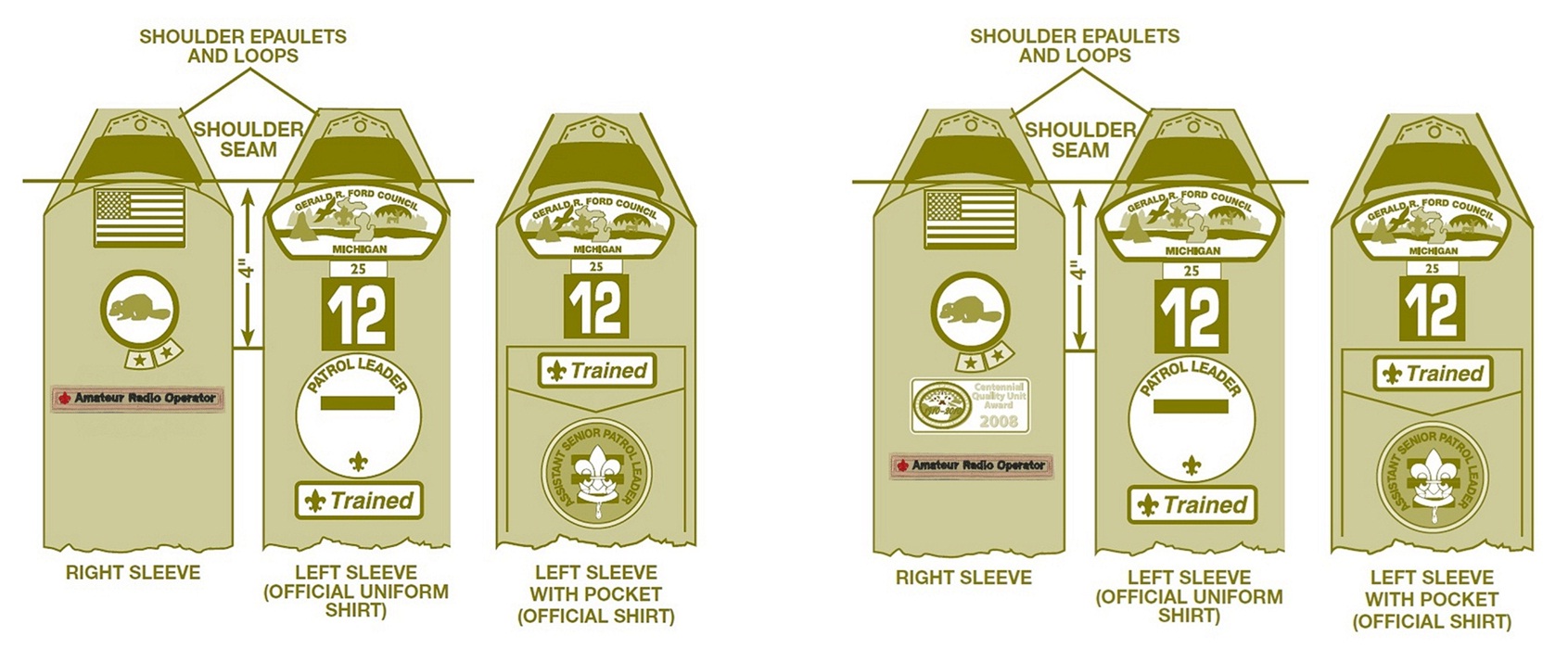
The Boy Scouts of America (BSA) has approved an Amateur Radio Operator rating strip for Scouts and Scouters to wear on their uniforms. According to BSA Communication Services Director Jim Wilson, K5ND, the strip recognizes the Scout or Scouter’s availability as an Amateur Radio operator for communication services for events and activities, as well as emergencies. All registered youth members and adult leaders who also hold a valid FCC-issued Amateur Radio license of any class are eligible to wear the rating strip.
“Last year, the BSA Awards and Insignia Committee introduced the Morse Code Interpreter Strip upon the recommendation of the BSA’s National Radio Scouting Committee,” Wilson told the ARRL. “We are always looking for ways to promote Amateur Radio, both within Scouting and to the world. The National Radio Scouting Committee thought this new Amateur Radio rating strip was a wonderful way to do exactly that, as it readily identifies to everyone that the wearer is a licensed radio amateur, prepared to be useful and to help others.”
Wilson, who heads up the National Radio Scouting Committee, said that the Amateur Radio Operator rating strip is similar to the Amateur Radio Operator badge offered as a proficiency badge by Scouts Australia, as well as the badge recently introduced by Scouting Netherlands. It follows in the footsteps of the Scout Radioman personal interest badge for Senior Scouts and Explorer Scouts that was offered by the Boy Scouts of America in the 1940s. The strip is worn on the right sleeve (see illustration below).


 http://www.arrl.org/images/view/News/BSA_ARO.jpg

 http://www.arrl.org/images/view/News/BSA_Insignia-both.jpg

Wednesday, January 16, 2013

LWRA Field Day/Pic-Nic

LWRA  Field Day/Pic-Nic
Welcome one and all to our next Event
The 2013 LWRA Winter Field Day and Pic-Nic will be held on Saturday, January 26th at Kiwanis Park in beautiful Lake Wales.  Kiwanis Park is located on Lakeshore Blvd. on the North West corner across from Big Lake Wales Lake.  Come out and join us for some good eats and lots of good visiting with all the LWRA members and playing Radio with us.  We well be setting up around 10:30-11 am and we will be there all afternoon.
Rich  (KJ4INW)

Amateur Radio "Technician Class" License Course and the General Class license upgrade course

Hillsborough County ARES/RACES is proud to sponsor 2 amateur radio courses: the introductory Amateur Radio "Technician Class" License Course and the General Class license upgrade course, all in a traditional classroom setting. Please invite your friends to come join the almost 400 people who have taken these courses and earned or upgraded an Amateur Radio license during the last few years. This course will be held on two Saturdays - the 19th and 26th of January, 2013.
Both classes will meet at the James A. Haley Veterans' Hospital, located at 13000 Bruce B. Downs Blvd., Tampa 33612. Class will start on both days at 9AM and continue until 5PM. On the 25th of January, 2013, testing will begin at 4:00PM.


There are no training fees for this class. However, there is a fee of $14 for taking the test, and the books are $19.95 and $29.95, depending upon which class you are taking. You will pay for the test and the book on the first day of class. Please bring a government-issued picture ID card with you, as well.
The class size is limited – and you can sign up online! In order to properly prepare materials and gauge class sizes, please send an email to training@hcaresraces.org to reserve your seat. If you are unable to attend both sessions of your course, please let us know about that as well - there is some scheduling flexibility for these classes.

Please check www.hcaresraces.org for information related to these classes, as well as other information related to emergency communications in our area. We look forward to seeing you and your friends and family there!
Keating
kc4hsi@gmail.com